Roof or Porro: what the prism actually changes
Two binoculars sit on a shop counter with identical numbers on the barrel: 8×42, same magnification, same objective diameter. One costs half as much as the other. Pick them both up and the difference is immediately tactile — different shapes, different balances, different philosophies of design. What separates them has less to do with the numbers than with what’s happening inside the body.
That gap is almost entirely a consequence of the prism sitting between the objective lens and the eyepiece. Everything else (the glass quality, the coatings, the focusing mechanism) can be identical in principle. The prism design determines the manufacturing complexity and the body shape. At the optical margins, it also determines what you see at the edges of the field.
Two ways to flip an image
A binocular’s objective lens produces an inverted image. The prism erects that image so the view through the eyepiece matches the real world. Both designs accomplish this, but through different geometry.
A Porro prism (named after Ignazio Porro, who patented the arrangement in the 1850s) uses two prisms in an offset configuration. Light enters, bounces off internal faces in the first prism, crosses to the second, bounces again, and exits correctly oriented. Because the two prisms are offset, the eyepiece can’t sit directly behind the objective — hence the characteristic dog-leg shape, with the eyepieces closer together than the objectives.
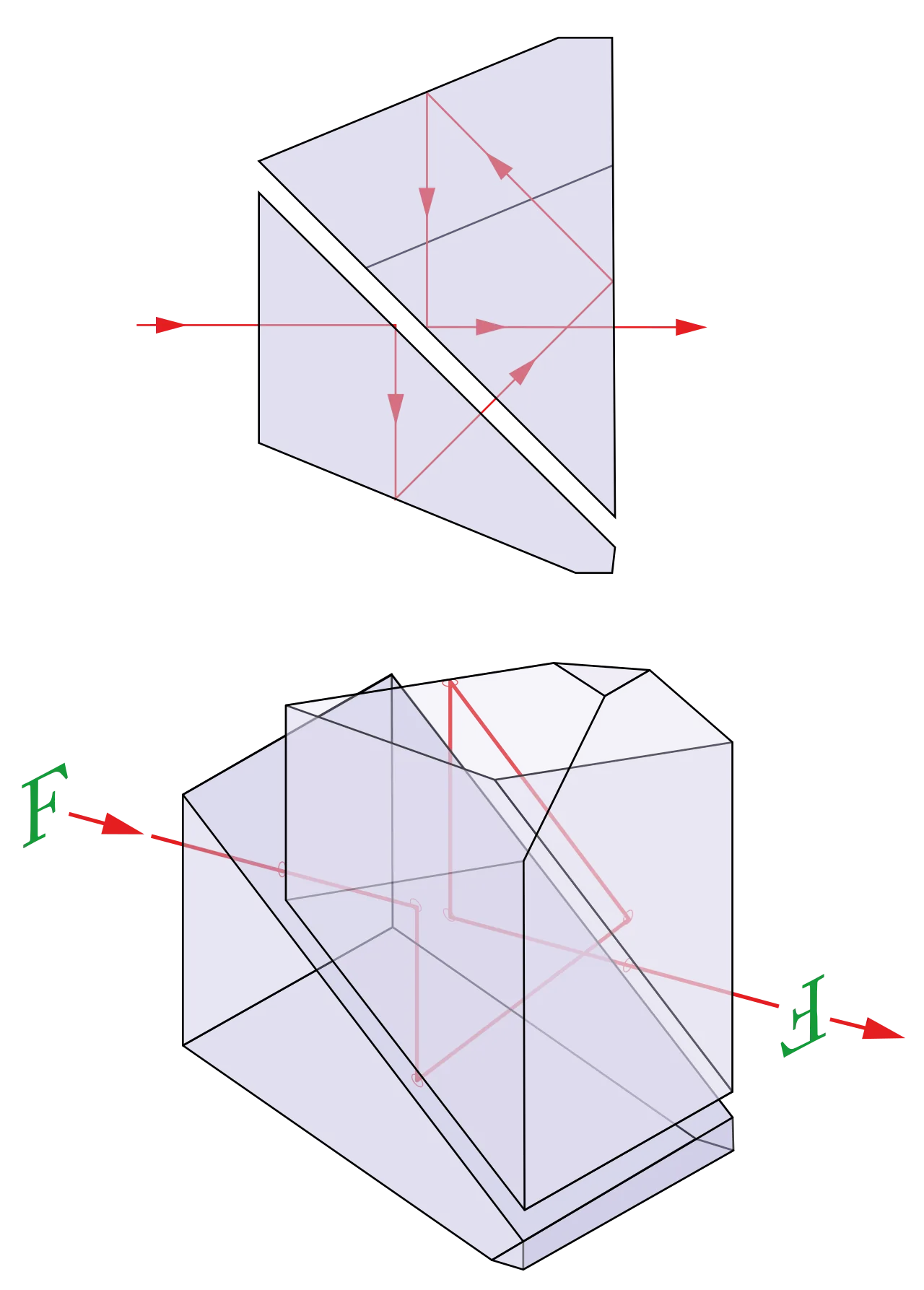
A roof prism folds the light path so that it enters and exits along roughly the same axis. The two main roof-prism designs are the Schmidt-Pechan and the Abbe-König. Schmidt-Pechan is more common in compact and mid-range binoculars; it uses a pair of prisms with a tiny air gap between them and requires a reflective coating on one surface because one internal reflection doesn’t meet the critical angle for total internal reflection. The Abbe-König design (used in some upper-tier instruments) uses a longer prism arrangement, at the cost of a slightly longer, heavier body.
The practical consequence is that a Porro prism can transmit light efficiently without the same coating expense as a Schmidt-Pechan roof prism. The Schmidt-Pechan design requires a mirror coating on one surface — historically aluminium, now typically silver or dielectric multilayer coatings — and even the best mirror coating absorbs a small fraction of light. This is one reason the Porro design, all else being equal, can be manufactured to a high optical standard at lower cost.
Phase correction: the tax on roof prisms
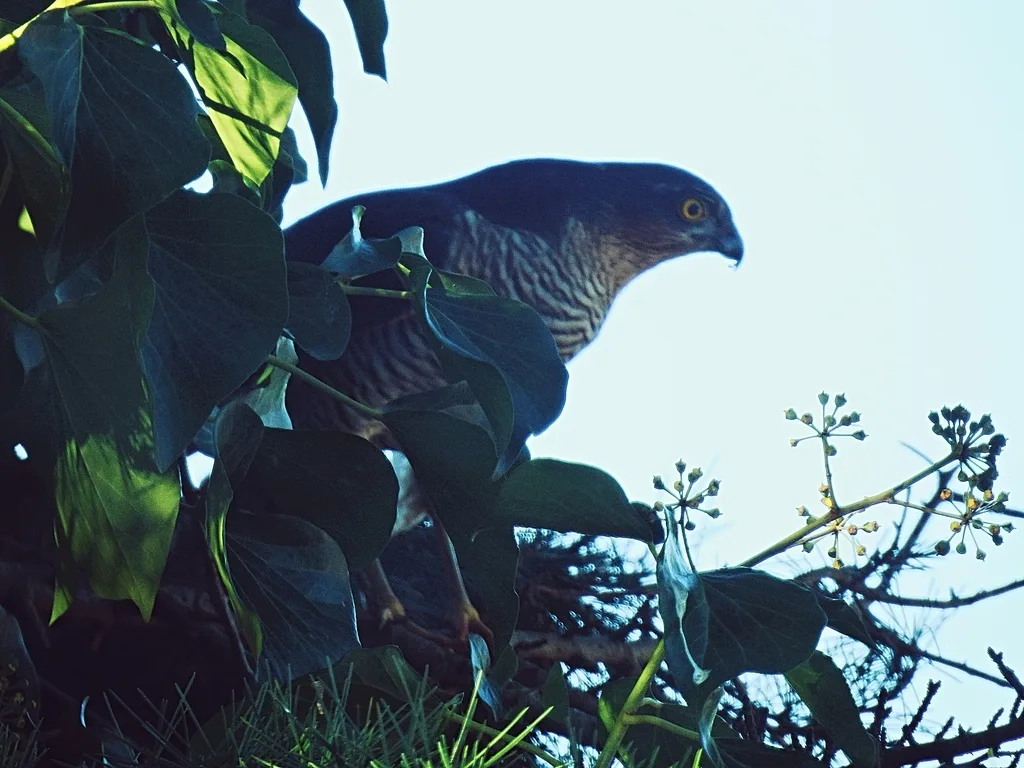
Here’s where the cost divergence really bites. When light reflects off the roof surface of a roof prism, the beam is split into two paths that travel slightly different distances before recombining. This introduces a phase shift — the two halves of the wavefront arrive out of step. The result is a subtle but real degradation: reduced contrast and resolution, most visible on fine detail like the barring on a sparrowhawk’s breast or the streaking on a pipit.
The fix is a multilayer interference coating on the roof surface, precisely calibrated to bring the two beam halves back into phase. This is sometimes called P-coating, and it’s standard on better roof-prism binoculars.
Porro prisms don’t split the beam this way, so the phase-shift problem simply doesn’t arise. This is why a mid-price Porro can deliver contrast and resolution that rivals a roof prism costing considerably more: it doesn’t have to buy its way out of a problem it never had.
What you carry, what survives
It is generally reckoned that the Porro holds an optical advantage at a given price point. But binoculars live in a jacket pocket, hang around a neck for six hours, and get rained on in November. The body surrounding those prisms shapes the experience just as much as the glass itself.
Size and weight. The offset barrels of a Porro make for a wider, bulkier instrument. Roof-prism binoculars, with their straight-through barrels, pack narrower and usually lighter for a given specification. Birders who walk long distances tend to favour the lighter option, and over a full day the weight difference becomes noticeable.
Roof-prism bodies, with fewer moving external parts and a simpler barrel geometry, are easier to seal against moisture and dust. Most modern roof-prism binoculars are O-ring sealed and nitrogen or argon purged as standard. Porro-prism binoculars can be sealed (some are) but the design makes it harder and more expensive, so many mid-range Porros are not fully waterproof. Weather sealing is a priority for coastal and estuarine birding, and the roof prism has a clear advantage here.
Roof-prism designs almost universally use internal focusing, where the moving elements are inside the sealed body. Porro-prism binoculars more often use external focusing bridges, which can allow dust or moisture ingress over time.
Durability. The Porro design has an inherent vulnerability: the prisms can be knocked out of alignment by a hard impact because they’re mounted in offset housings. Roof-prism binoculars are the more mechanically robust option for regular field use.
Where each design earns its place
The honest answer to “am I paying for fashion?” is: partly, but not entirely.
At the lower end of the mid-range, a good Porro-prism 8×42 or 10×50 can outperform a roof-prism binocular at the same price on pure optical merit. The Porro delivers better contrast, brighter images, and a wider, more natural depth perception (the offset objectives create a slightly exaggerated stereo base, which some birders find gives a more three-dimensional view). If you bird mainly from a car, a hide, or your garden — contexts where bulk is less of a penalty and weather sealing is less critical — a Porro is often the sharper choice for the money.
The roof prism earns its premium when the full package matters: lighter weight for long carries, reliable weather sealing for coastal and upland birding, greater mechanical robustness for years of field use.
The middle of the market is where the choice is genuinely difficult. A roof-prism binocular in the mid-price bracket without phase correction, or with a basic aluminium mirror coating, may actually deliver a softer, lower-contrast image than a Porro at half the price. This is the trap: assuming the slimmer body means better optics. It doesn’t, necessarily. Checking what coatings are present matters more than reading the magnification and objective diameter, and manufacturers are not always forthcoming about the details.
The short version
| Porro | Roof | |
|---|---|---|
| Light path | Offset, inherently phase-neutral | Straight-through, requires phase correction |
| Mirror coating needed | No | Yes (Schmidt-Pechan) |
| Typical body | Wider, heavier | Narrower, lighter |
| Weather sealing | Possible but less common | Standard in most models |
| Close focus | Often longer | Often shorter |
| Mechanical robustness | More alignment-sensitive | More impact-tolerant |
| Cost for equivalent optics | Lower | Higher |
The prism is the reason a slim roof-prism binocular costs more than a chunky Porro with the same numbers on the barrel. Some of that cost buys real engineering — coatings to solve problems the Porro never encounters, sealing the Porro struggles to match. The rest buys convenience and durability. Whether that’s worth the premium depends on how you bird, where you bird, and how long you plan to stand in the rain watching gulls that all look the same.